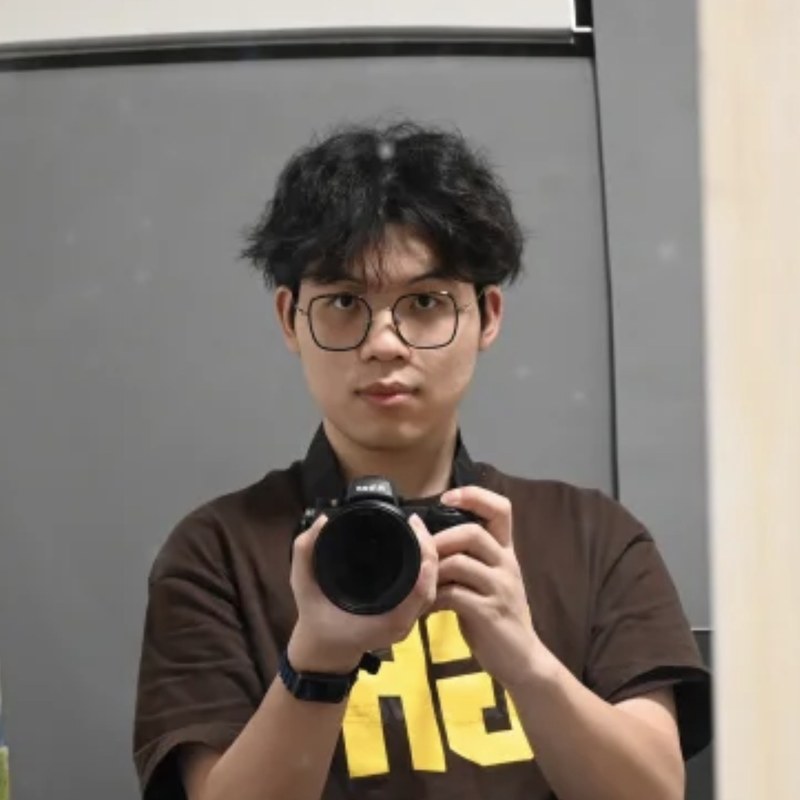
I am a Ph.D. candidate in the Department of Electrical and Computer Engineering at The University of Hong Kong (HKU), advised by Prof. Can Li.
My research focuses on in-memory computing and efficient hardware for AI, including compute-in-memory architectures based on emerging non-volatile memories (e.g., ferroelectric field-effect transistors and memristors), reliable analogue computing with imperfect devices, and hardware acceleration for Bayesian inference and nearest-neighbor search.
My work has been published in Nature Electronics, Nature Communications, IEEE Transactions on Computers, DAC, DATE, and ICCAD.
Warning
Problem: The current name of your GitHub Pages repository ("Solution: Please consider renaming the repository to "
http://".
However, if the current repository name is intended, you can ignore this message by removing "{% include widgets/debug_repo_name.html %}" in index.html.
Action required
Problem: The current root path of this site is "baseurl ("_config.yml.
Solution: Please set the
baseurl in _config.yml to "Education
-
 The University of Hong KongAug. 2023 – presentDepartment of Electrical and Computer EngineeringPh.D. Candidate
-
 Zhejiang UniversitySep. 2019 – Jun. 2023B.S. in Microelectronics
News
Selected Publications (view all )

Fault-free analogue computing with imperfect hardware
Zhicheng Xu, Jiawei Liu, Sitao Huang, Zefan Li, Shengbo Wang, Bo Wen, Ruibin Mao, Mingrui Jiang, Giacomo Pedretti, Jim Ignowski, Kaibin Huang, Can Li
Nature Electronics 2026
Analogue in-memory computing computes directly within memory, but device failures and variations limit its precision and reliability. We report a fault-free matrix representation that decomposes any target matrix into two adaptive submatrices programmed onto the analogue hardware, allowing optimization to bypass faulty devices. Our memristor-based system achieves a cosine similarity of over 99.999% for a discrete Fourier transform matrix despite a 39% device fault rate.
Trustworthy tree-based machine learning by MoS2 flash-based analog content-addressable memory with inherent soft boundaries
Bo Wen, Guoyun Gao, Zhicheng Xu, Mingrui Jiang, Ruibin Mao, Xiaojuan Qi, Jiezhi Chen, Xunzhao Yin, X. Sharon Hu, Can Li
Nature Communications 2026
Tree-based models such as Random Forest excel in interpretability and accuracy for tabular data, but scaling them on hardware is hard because sharp decision boundaries are highly susceptible to device variations. We present a hardware-software co-design using MoS2 flash-based analog content-addressable memory with inherent soft boundaries, enabling efficient and trustworthy inference with soft tree-based models.
FeReX: A Reconfigurable Design of Multi-Bit Ferroelectric Compute-in-Memory for Nearest Neighbor Search
Zhicheng Xu, Che-Kai Liu, Chao Li, Ruibin Mao, Jianyi Yang, Thomas Kämpfe, Mohsen Imani, Can Li, Cheng Zhuo, Xunzhao Yin
Design, Automation & Test in Europe Conference (DATE) 2024
A reconfigurable multi-bit ferroelectric compute-in-memory design for nearest neighbor search.